
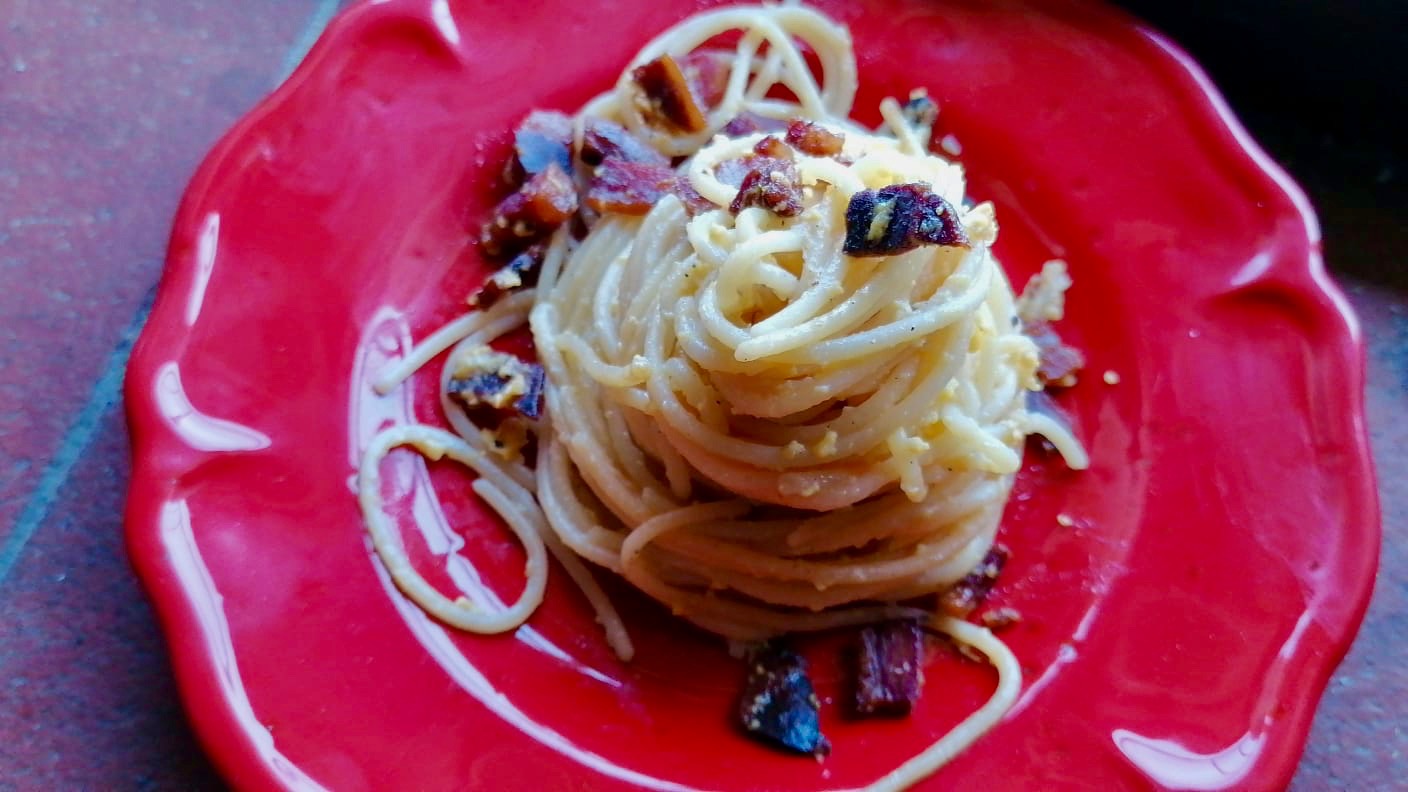
Carbonara is a must and a mystery of Italian cuisine.
Where and when was it invented?
Different stories exist about the origins of this recipe, which has its own World Carbonara Day, celebrated on April 6th.
The recipe for pasta alla carbonara
You’ll need good guanciale (cured pork cheek) cut into coarse strips, a few eggs (reserving the yolk), plenty of grated Pecorino Romano DOP, and your choice of long or short pasta: Spaghetti, rigatoni, or mezze maniche rigate are the most suitable shapes, and, to finish, pepper to taste.
RECIPE CARBONARA SAUCE
Ingredients
For 5/6 persons
5 fresh eggs
200 gr. =7 ounces Guanciale (cheek) or pancetta
60 gr. =1/4 cup pecorino cheese
2 cloves garlic
2 tbs. EVOO
1 pinch salt
1 pinch pepper (or more)
Tools
1 knife
1 cutting board
1 small bowl
1 fork or whisk
1 ladle
1 pan
Preparation
- While the water for the pasta is on the fire
- Cut the guanciale or pancetta into strips not too thin (and not too long!)
- Pour 2 table spoons of EVOO and two cloves of garlic in a pan, fry lightly, then take the garlic out
- Add the guanciale and brown it in the hot pan. The guanciale should not harden by frying too much, but must soften gently, releasing all the “fat” to sauté the pasta in the pan.
It will take about 3 minutes: the guanciale will become crispy and the fat transparent. The fat that the guanciale has sweated in the pan is kept and the cooked and crispy cured meat is transferred to a small bowl.
Separate 4 yolks from the whites.
- Grate the pecorino cheese
Place the egg yolks in a bowl, add the pecorino, a sprinkling of black pepper and two tablespoons of the cheeck/bacon fat, mixing everything together with a spatula
- Beat 4 yolks and 1 egg, half of the cheese ,pepper
- Boil the pasta in plenty of salted water.
- Keep two ladles of the boiling salted water (you’re cooking the pasta with)in a bowl
- Drain the pasta and put it in the pan where the guanciale/pancetta was coooked
With the heat completely off, add the egg yolk cream
- Add the eggs, and mix well
- Add some of the water from the pasta.Probably 1 ladle is enough. Usually more for the pici pasta as they tend to absorb more the liquid than spaghetti/dry pasta.
- Serve with a good amount of grated pecorino cheese
HISTORY-ORIGIN
One theory traces the origins of this dish back to the Lazio pasta “cacio e ova”(cheese and eggs), prepared by both shepherds and woodcutters who went to the mountains to make charcoal: the “carbonari” (hence the name of the dish) carried this pasta in their haversacks, to be eaten , while they watched over the charcoal kilns.
The first appearance of a dish vaguely similar to carbonara dates back to 1881: Francesco Palma, in his book “The Prince of Chefs,” introduces a pasta dish with eggs, lard, and cheese.
Some food historians also trace the origins of this dish to Strascinati di Cascia, a popular Umbrian recipe made with sausage, pancetta, eggs, and pecorino cheese, mentioned in a 1931 Touring Club guide.
The Bolognese chef, official cook for the Anglo-American troops stationed in Riccione, finds himself tasked with preparing a lunch for the supreme commander of all Allied forces in Italy to celebrate the liberation of Rimini and Riccione.
Nearby, however, the war is still raging, resources are limited, and Gualandi improvises using what he has on hand at the American camp: freeze-dried egg yolk, cream some type of cheese and finally bacon. He finishes the dish with a twist of black pepper.
Gualandi then became the official chef of the Allied troops stationed in Rome . Within seven months, his first dish had become a cult classic, thanks to its relative ease of preparation and the abundance of ingredients already supplied to the US Army.
The trend was gaining traction: soldiers on leave wandering around the city frequented taverns and restaurants, asking around who could cook that perfect pasta. Cesaretto alla Cisterna was perhaps among the first to embrace the novelty. Depending on the availability of local ingredients, in Rome, bacon gradually became guanciale, cheese became pecorino.
The recipe also spread to Lucca, where it began to be prepared with local pancetta instead of bacon. Young Pietro Lencioni, who had arrived from Chicago a decade earlier with his mother and father, treasured it and set sail for the US to try his luck. After a long apprenticeship in bars and clubs, he opened an Italian restaurant with his partner Armando.
In Rome, carbonara was now everywhere: Luigi Carnacina, a close friend of Gualandi, chose to present in his masterpiece collection a version as close as possible to the Bolognese chef’s. So, cream, butter, and Reggiano were the order of the day.
And the first recipe published in the magazine “La Cucina Italiana” dates back to 1954, and the ingredients included garlic, bacon, Gruyère, eggs, and pepper!
CARBONARA TODAY
Whatever its origins, carbonara seems to have its roots in an ancient way of cooking, and its subsequent encounter with the United States, and certainly the combination of simple ingredients—eggs and bacon—was perfect for everyone.
In subsequent years, the recipe was modified, becoming the subject of much debate among industry experts and consumers, and today, for most, adding cream to pasta “alla Carbonara” is considered downright sacrilege.
The use of guanciale certainly takes it to a higher level because it is a remarkable cured meat, spiced with aromatic herbs.
So ,what to say. Sincerely so many people like this dish and forget to know where its comes from. Let’s enjoy it, anyway.
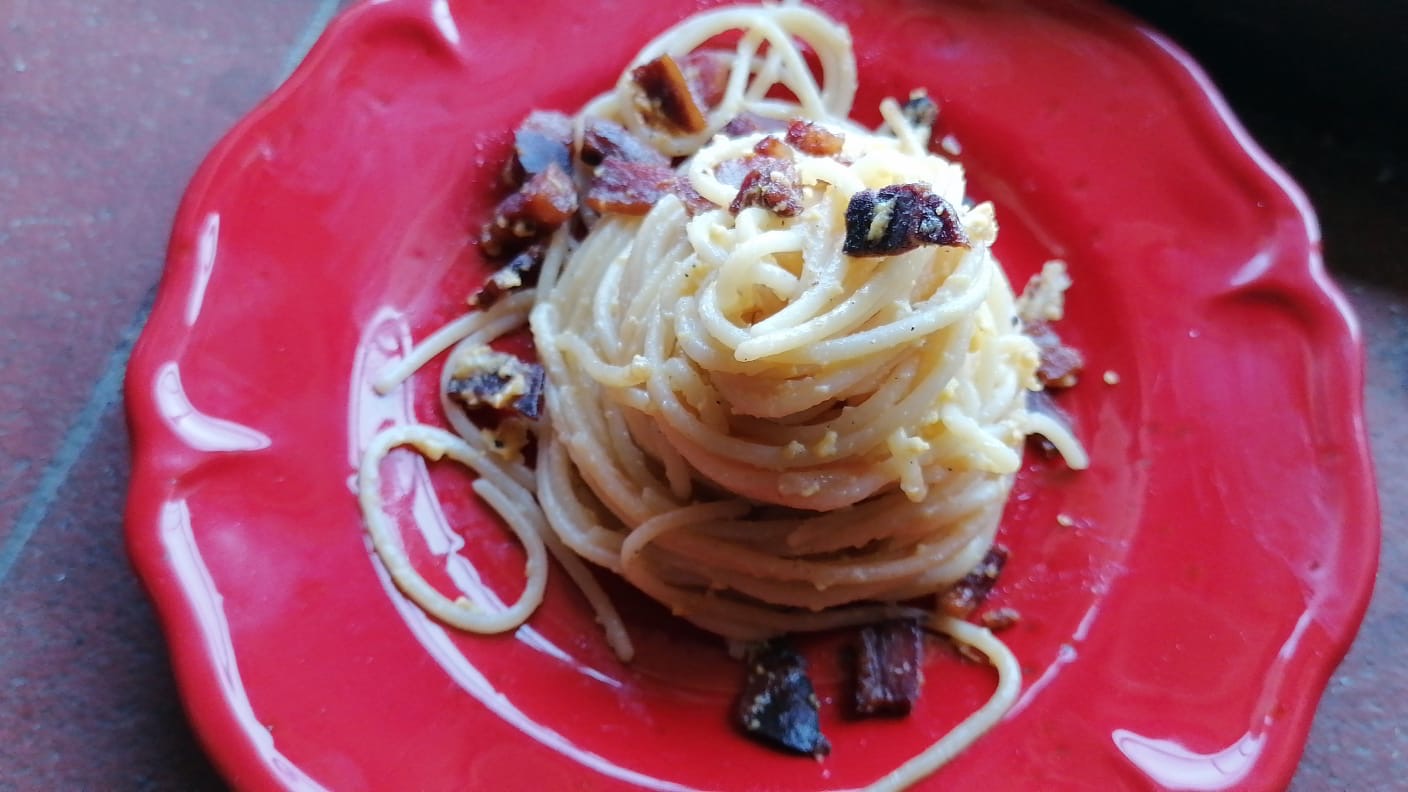
Buon appetito!
 Toscana Mia Blog
Any Italian recipe can be loosely traced back to the Romans. This one, and it is a great one, is best remembered as it was
Prepared in Nonna’s kitchen on a Thursday night as she wondered what to make for dinner. Prepared with all fresh ingredients and a big touch of love
But you gotta understand. I am trying to lose weight. You’re no help at all my friend! 🤣🤣
LikeLike
So nice you remember Nonna’s kitchen. We promise:next time a recipe good for a diet !
LikeLike