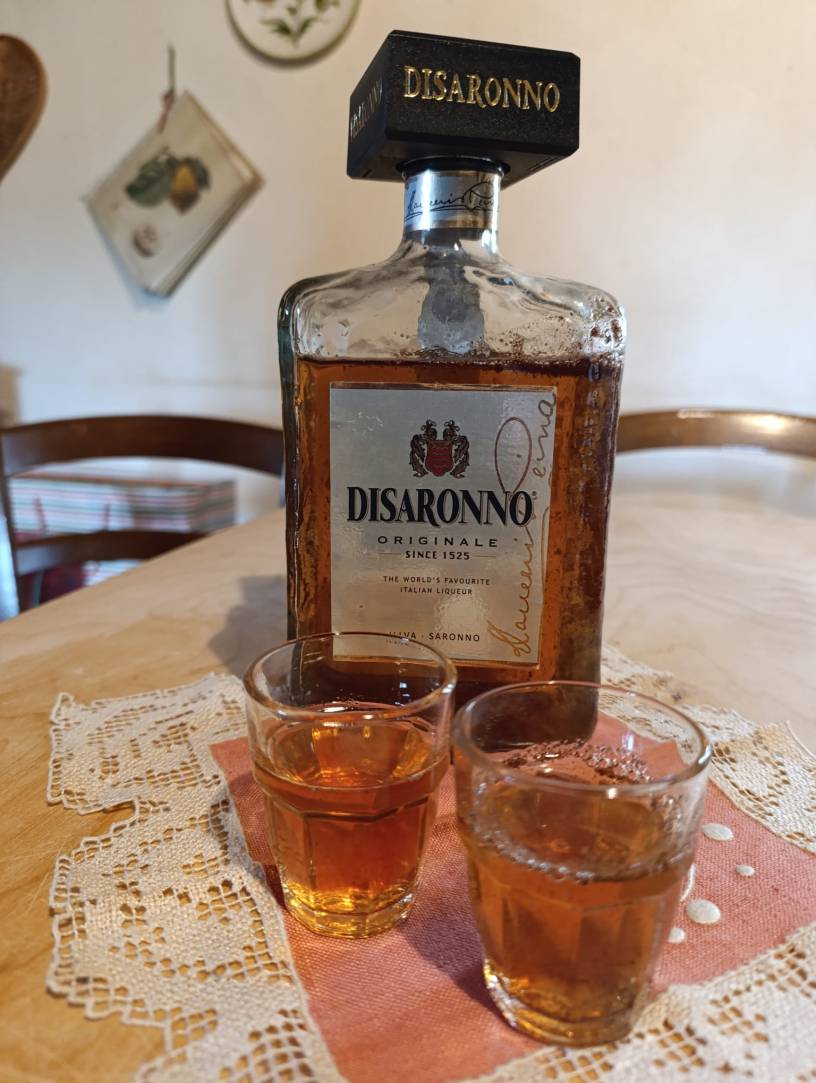
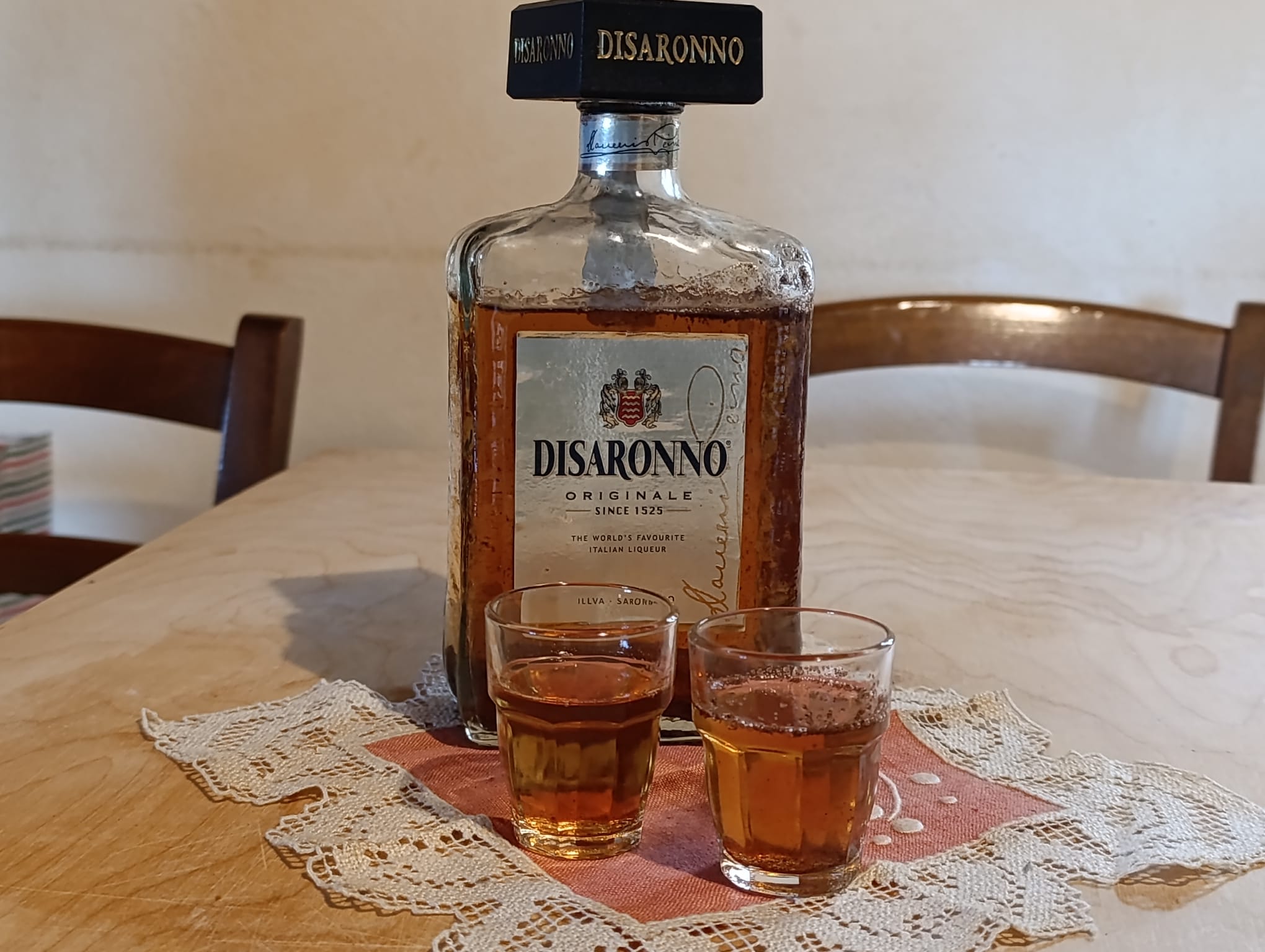
Amaro means bitter, but when we talk about amaretto we always think of something sweet. More precisely, there are two options: the liquid one, known as liqueur, and the solid one, represented by amaretto cookies. Both have deep roots in Italian tradition and are closely linked to Saronno, in Lombardy (Northern Italy).
Today we’re talking about the liqueur because the Christmas period is perfect for amaretto, and it reminds me of the early years in Chianti when our neighbor always asked our dad to buy him a Saronno Amaretto in town, and that was his Christmas gift for the next twenty years.
Features
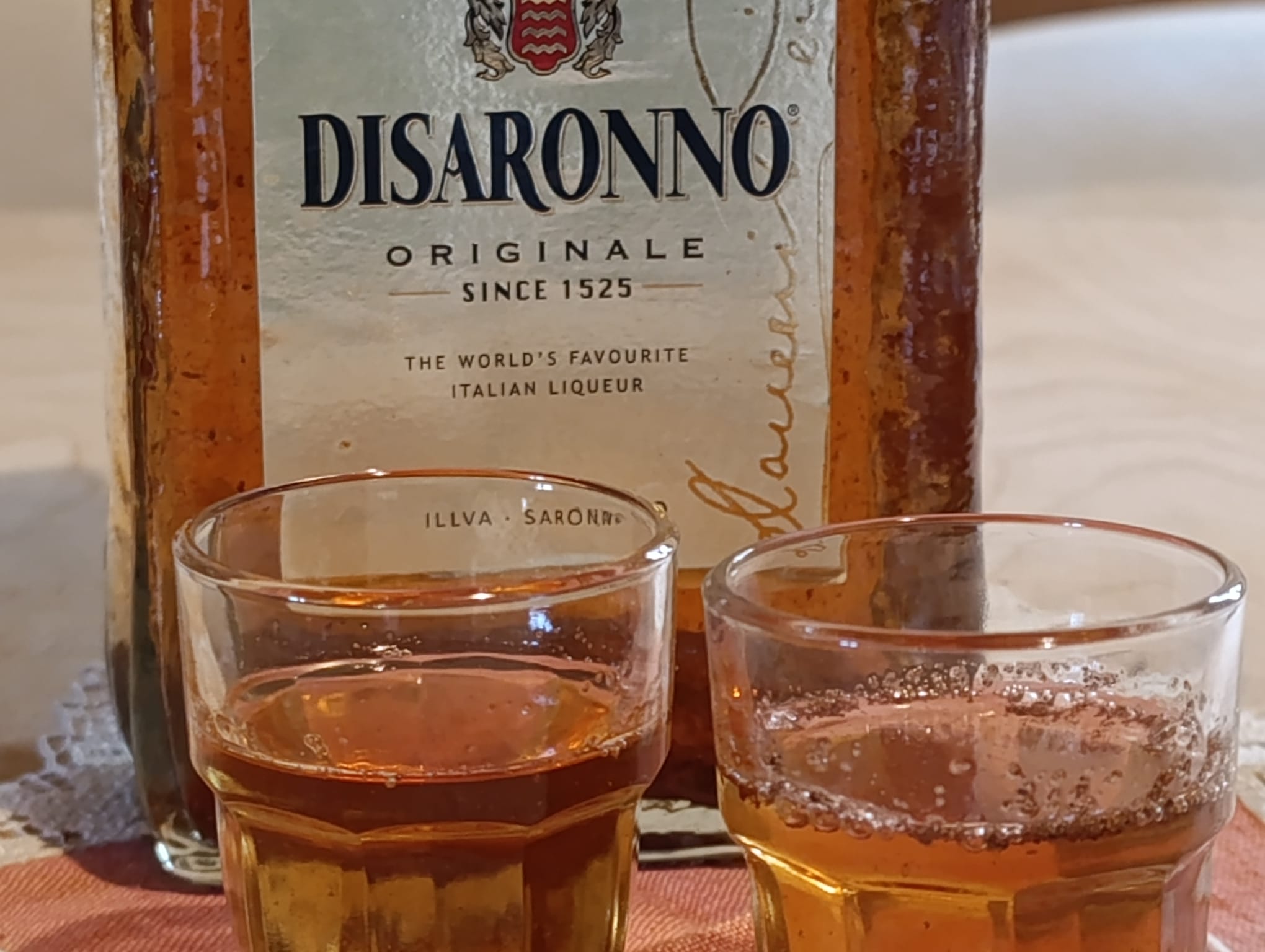
Saronno Amaretto is an amber-colored liqueur, one of the most famous Italian liqueurs, known for its sweet and aromatic taste with hints of almond and vanilla. It is a versatile ingredient, used both in mixology and in baking.
Origin and History of Saronno Amaretto
The origins of Saronno Amaretto date back to the 16th century and are wrapped in a romantic legend.
It is said that in 1525, the painter Bernardino Luini, a student of Leonardo da Vinci, was commissioned to paint a fresco in the church of Saronno. To find inspiration for the Madonna of Miracles, he chose a young innkeeper as his model, who, to thank him, prepared an infusion of herbs and almonds in brandy. This sweet-and-bitter tasting elixir became known as Saronno Amaretto.
Commercial production began in 1851, when the Reina family founded the company Illva Saronno, which is still the main producer of the original Disaronno today.
Ingredients of Saronno Amaretto
Contrary to what you might think, the characteristic flavor of this liqueur comes from apricot kernels, which develop an almond-like aroma.
Let’s take a look in detail at the main ingredients of Saronno Amaretto:
• Apricot Kernels
• Almonds, sometimes added
• Vanilla
• Selected Herbs and Spices
• Caramelized Sugar
• Alcohol – the alcoholic base that allows the ingredients to macerate and create the liqueur.
It has an alcohol content of about 28% vol. and is characterized by an amber color and a slightly syrupy consistency.
How Is Amaretto di Saronno Made?
The production of Amaretto di Saronno follows several key steps:
. Infusing apricot kernels
. Adding secret herbs and spices
. Sweetening with sugar
. Maturing and filtering
. Bottling
How to Drink Amaretto di Saronno
This is a very versatile liqueur and can be enjoyed in different ways:
Neat or on the rocks
Perfect as a digestif after meals, served at room temperature or with a few ice cubes to enhance its sweetness.
In Cocktails
Amaretto is a highly appreciated ingredient in mixology and is used in several cocktails:
• Amaretto Sour → Amaretto, fresh lemon juice, sugar syrup, and egg white.
• Godfather → Amaretto and whisky, for a bold-tasting drink.
• French Connection → Amaretto and Cognac, for an elegant cocktail.
• Toasted Almond → Amaretto, Kahlúa, and milk, for a creamy beverage.
With Coffee or in Milk
A teaspoon of Amaretto in coffee or hot milk gives it an irresistible aromatic note.
Amaretto di Saronno Uses in Cooking
Amaretto di Saronno is an aromatic liqueur with a sweet almond taste, perfect for enhancing a wide range of both sweet and savory dishes. Its unmistakable aroma makes it a much-loved ingredient in cooking, not only as a digestif or cocktail ingredient but also as a distinctive element in many traditional Italian recipes.
Some of the most common uses include:
• Sweets and desserts: it’s perfect for flavoring tiramisu, creams, semifreddos, ice creams, and spoon desserts. It’s often used to soak sponge cake, giving it a sophisticated and fragrant touch.
• Cookies and dry pastries: Amaretto is the star in recipes like soft amaretti, cantucci, or rustic baked sweets, where it enhances the almond flavor.
• Gourmet savory dishes: in some creative kitchens, it’s used to deglaze white meats or roasts, or to flavor sweet-and-sour reductions to accompany aged cheeses.
• Cocktails and drinks: beyond the classic Amaretto Sour, it can be added to coffee, hot chocolate, or cold drinks for an aromatic twist.
Practical tip:
When using Saronno Amaretto in cooking, it’s always best to use it carefully so as not to overpower the other flavors, but rather to enhance them.
Curiosities about Amaretto di Saronno
The real Amaretto di Saronno is produced only by the company Illva Saronno and is sold under the Disaronno Originale brand.
• The iconic bottle with the square cap was introduced in the 1970s and makes the liqueur instantly recognizable. • The term “Amaretto” comes from “amaro,” due to its slightly bitter aftertaste.
• Despite the almond flavor, it doesn’t always contain almonds.
Frequently Asked Questions
Does it contain almonds? No, its flavor comes from apricot kernels, which release an almond-like aroma.
Is it gluten-free? Yes, it is naturally gluten-free and suitable for celiacs.
What’s the difference between Amaretto di Saronno and Disaronno? Disaronno is the brand name of the company Illva Saronno, while “Amaretto di Saronno” is the generic name of the liqueur.
Can Amaretto be drunk on its own? Yes, it’s great as a digestif, served neat or on the rocks.
This liqueur is an Italian excellence appreciated worldwide. With its sweet and enveloping flavor, it’s perfect to enjoy on its own, in cocktails, or as an ingredient for refined desserts. If you want to enrich your tasting experience, try using it in your favorite recipes!
Salute!Cin Cin!

